The 11 Nines of Durability: How Amazon S3 Storage Architecture Prevents Data Loss at Scale
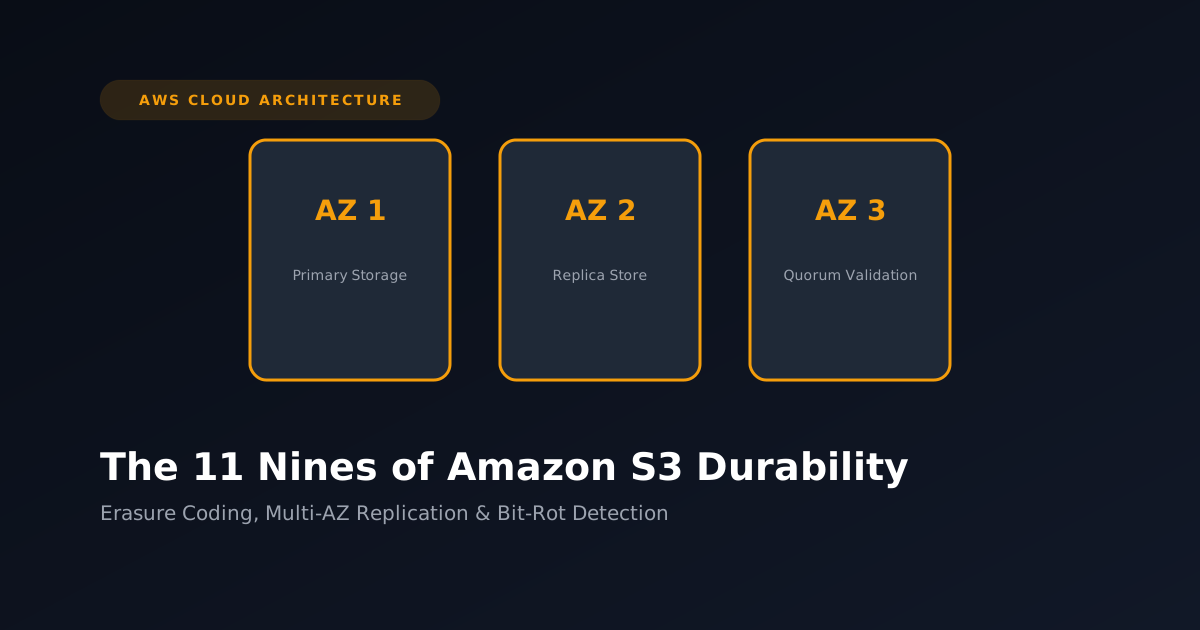
When AWS promises 99.999999999% (11 nines) of annual durability for objects stored in Amazon S3, it means that if you store 10,000,000 objects in S3, you can expect to lose a single object once every 10,000 years.
Achieving this staggering level of fault tolerance requires an engineering masterclass in distributed system design, redundancy, and background data scrubbing.
The Core Foundations of S3 Durability
Amazon S3 does not simply write your data to a single hard drive or RAID array. When a storage request succeeds, S3 guarantees that your object has been safely committed across multiple independent facilities.
1. Multi-Availability Zone (AZ) Synchronous Replication
Every standard AWS Region consists of at least three geographically isolated Availability Zones (AZs) connected via private ultra-low-latency fiber.
When an object payload arrives at an S3 Storage Node:
The payload is chunked and written across independent physical racks in the primary AZ.
The data is synchronously replicated across at least three separate AZs before returning success.
Even if an entire data center experiences a total power outage or natural disaster, data integrity remains 100% intact.
2. Erasure Coding vs. Simple Replication
Simple 3x replication (storing three full copies of a file) incurs a 200% storage overhead cost. To optimize cost efficiency while enhancing durability, S3 utilizes advanced Reed-Solomon Erasure Coding:
A data object is divided into data fragments and parity fragments.
Any subset of data fragments out of the total fragments is mathematically sufficient to reconstruct the original data payload.
This allows S3 to sustain simultaneous hardware node failures without data corruption while maintaining minimal storage overhead.
3. Continuous Bit-Rot Detection and Self-Healing Scrubbers
Hard drives and SSDs suffer from silent data corruption (bit-rot)—spontaneous flipping of binary 1s and 0s over time due to cosmic rays or magnetic decay.
To counter this, Amazon S3 executes autonomous background scrubbers that continuously compute cryptographic checksums (CRC32C / SHA-256) during idle I/O cycles. If a checksum mismatch is detected, S3 automatically discards the corrupted block and rebuilds a pristine copy onto fresh storage media.
Summary for Cloud Architects
Never fear single-drive or single-facility failures when storing data in S3 Standard.
Leverage S3 Object Lock and Multi-Factor Authentication (MFA) Delete to guard against human operator errors and ransomware attacks.
Subscribe to Engineering Insights
Get weekly in-depth technical guides on AI Agents, system architecture, and cloud infrastructure delivered straight to your inbox.